

Hacktoberfest Dropped Its Pull Request Count Over AI Spam
Hacktoberfest stopped counting pull requests after AI-generated spam overwhelmed maintainers, and the same fix saves any swamped intake process.
Hacktoberfest has run every October since 2014: open four pull requests, get a T-shirt or some stickers, and open source projects get a wave of new contributors. This year the organizers, Major League Hacking and DEV, working with DigitalOcean, pulled the one mechanic that made the whole thing work. Pull requests no longer count toward any reward. You can't earn anything by opening one anymore.
The reason is blunt. AI makes it trivial to generate a plausible-looking pull request in seconds, and thousands of people did exactly that to collect a sticker. Maintainers spent recent Octobers triaging patches that fixed a typo in a README, reworded a comment, or "fixed" something that wasn't broken, written by a tool with no understanding of the codebase. GitHub flagged the same pattern back in February 2026, when it said it was weighing whether to turn off pull requests from untrusted accounts entirely, limit them to trusted collaborators, or route them through AI triage first. One engineer quoted in the coverage put it bluntly: roughly one in ten AI-assisted pull requests was actually worth a maintainer's time.
Counting submissions was never the same as judging them
For twelve years, Hacktoberfest rewarded an action: open a PR. It never asked whether the PR was any good. That worked fine while writing a pull request took real effort. Once a tool could produce one in the time it takes to type a prompt, the reward kept paying out for volume while the actual cost, a maintainer's attention, stayed exactly as scarce as before. The programme didn't get more popular. It got flooded.
That isn't really a story about AI. It's what happens to any intake process the moment submitting gets cheaper than reviewing.
The same failure shows up inside companies
Picture an internal idea programme at a mid-size company. Anyone can submit an idea for a new feature or process improvement, and submitting one counts toward a team goal or a raffle entry. That worked fine for years, because writing up an idea properly took a lunch break. Then someone notices that a chatbot can turn "cut onboarding time" into a polished-looking one-pager in ninety seconds, and the innovation team that used to review 15 ideas a month is suddenly looking at 140, most of them a paragraph of plausible filler with no owner and no numbers behind it. Reviewers either rubber-stamp everything to keep up, or quietly stop reading past the first page. Either way, the programme stops finding good ideas, for the same reason Hacktoberfest stopped working: it rewarded the act of submitting, not the merit of what got submitted.
The fix GitHub and Hacktoberfest reached for, limiting who gets to submit or triaging with another AI, treats the symptom. The sturdier fix is to score every submission against the same weighted criteria before a human spends time reading the prose, so volume stops being the thing that wins by default.
What that looks like in practice
Say the innovation team sets its weights ahead of time: business impact at 35%, feasibility at 25%, cost to implement at 25%, strategic fit at 15%, adding up to 100%. Every idea gets scored on a 1-5 scale against those four criteria before anyone reads the write-up in full. A one-paragraph idea with no numbers behind it scores low on feasibility and impact automatically, whatever wrote it. A real idea with a named owner and a rough budget rises to the top of the queue regardless of how many throwaway submissions arrived around it. The team stops reading everything and starts reading what already cleared the bar.
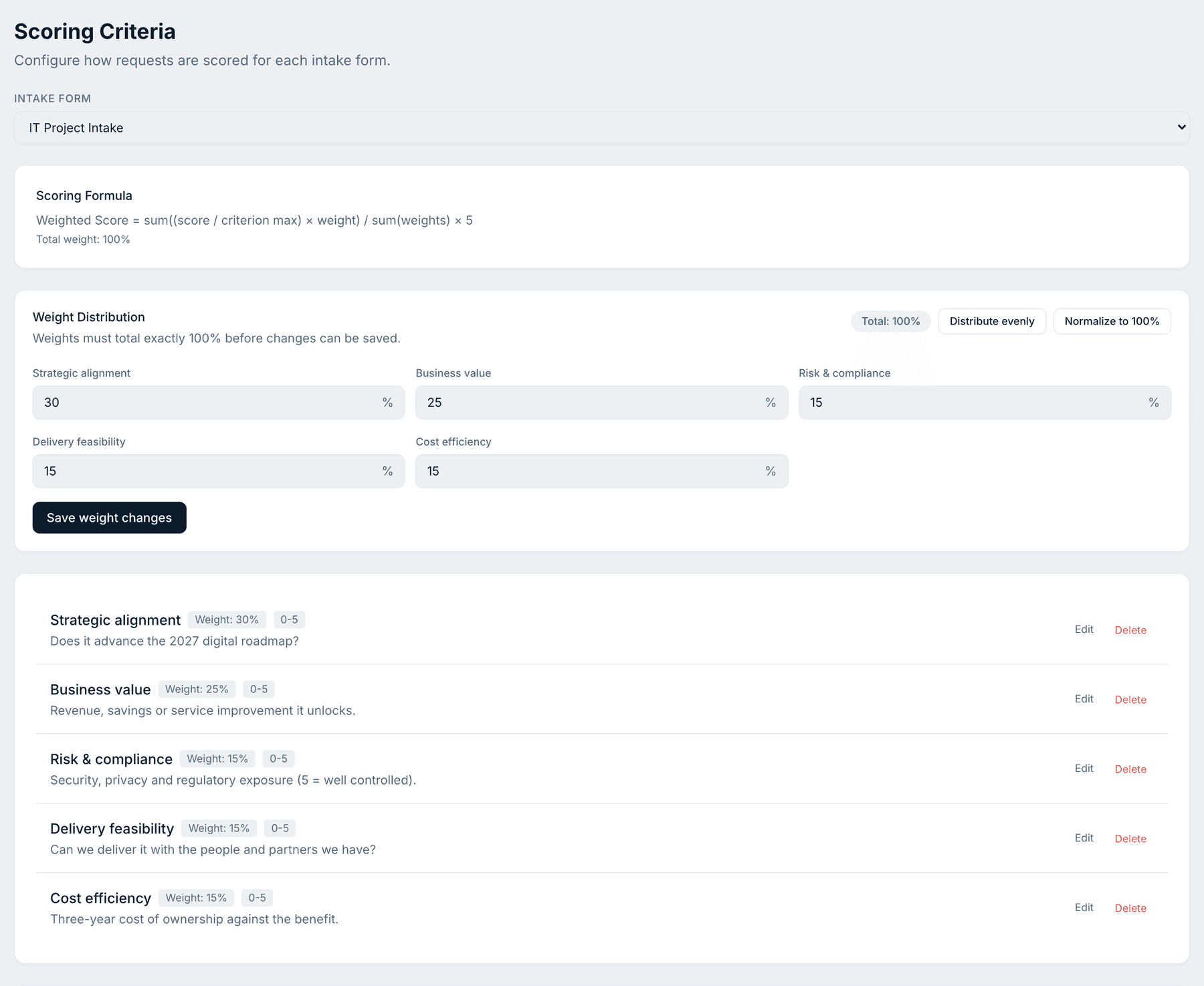
That's the same structure Admitura uses for project requests: a submitter fills in a form, the request is scored against weighted criteria the team sets once, and a reviewer adds a structured assessment before anyone decides. The scoring step is what Hacktoberfest's old leaderboard, and most "just submit it" programmes, never had.
Weighted scoring isn't specific to code or innovation ideas. Any process where more than a handful of submissions land each month needs it, whether that's a project intake queue or a formal scoring model. Once scoring is in place, submission volume can rise without the review queue collapsing under it.
Admitura keeps a request, its scores, reviews and conversation in one place. Try it free.
Sources: Hacktoberfest 2026 FAQ, Hacktoberfest, checked October 23, 2026; Hacktoberfest 2026: what changed, DEV Community, checked October 23, 2026; GitHub weighs pull request kill switch as AI slop floods open source, Open Source For You, February 2026.